TonttuStudio — open source music studio, new life for old FireWire iMac
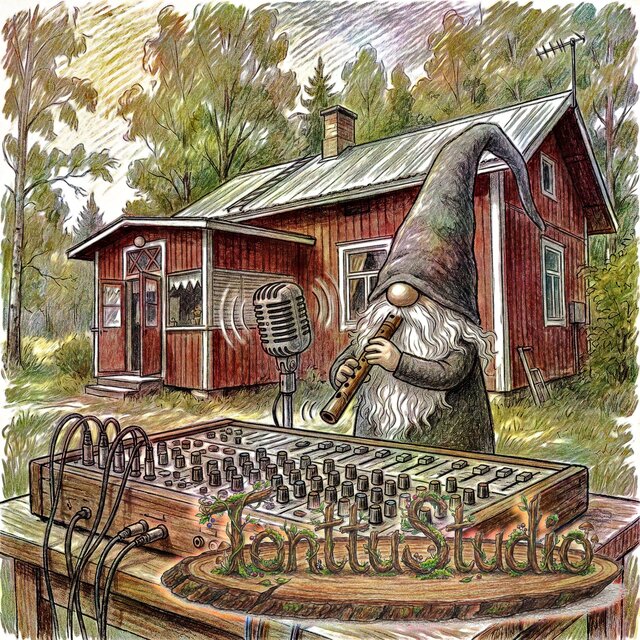
TonttuStudio
Open source music studio, new life for old FireWire iMac
TonttuStudio is a folk-rooted home studio built on one principle: a few pieces of quality hardware, everything else in software.
Modest in scale, playful, rooted in acoustic Finnish and Nordic folk instruments. Flute, kantele, accordion, voice, didgeridoo — alongside synths, drum machines and live looping — all flowing through one short signal path into an old 2011 iMac, where every plugin, every effect, every synthesis voice is open-source software.
The whole studio is built from second-hand gear. Only good audio is pro audio — so the gear is professional grade, bought used, given a second life. The hardware principle mirrors the software principle: open source for one, recycled for the other.
Why the inversion
Traditional studios have their own real advantages — analog warmth, hands-on workflow, decades of refined craft. This is not a critique of them. The choice here is different, with its own merits:
🎯 Signal path purity. One short analog hop — instrument → microphone → interface — then everything is digital, with no further degradation along the chain.
💶 Price. Open-source DSP is free. The commercial hardware it replaces costs a lot.
🌱 Environmental. Less new hardware in the world. Longer life for old hardware. Less electronic waste.
💾 Recall. Software setups can be backed up, version-controlled, recalled exactly, and carried in a backpack.
The acoustics of nature
The most valuable part of the studio was never for sale. A city studio pays dearly for silence — thick walls, floating floors, foam to keep the world out. Here the silence comes free: the middle of nature, the deep quiet of a Finnish night, a noise floor no money can buy.
And when you stop shutting the room out and let it in, it brings its own players — birdsong threaded through a take, frogs playing bass on a summer evening. It isn't noise — it's part of the music.
The one piece of analog
In a studio where almost everything lives in software, the short analog stage that remains carries all the weight. Sound crosses into the computer only once — through a microphone, a preamp, and analog-to-digital conversion — and nothing further down the chain can recover what is lost or coloured there. So this is where the care goes: quiet, clean mic preamps and honest conversion. Everything after is only ever as good as the signal that first arrived.
Keeping all of that — preamps, conversion and routing — in a single well-made unit means one short path instead of a rack of separate boxes and the cabling between them. For Linux the deciding factor is the driver. A converter carried by the mainline kernel keeps working across kernel and library updates with nothing extra to maintain — here it's snd-fireface, which runs the interface natively, no vendor software in the loop. The unit in use is an RME Fireface 400 — pro-grade and repairable, bought used.
The host is an old 2011 iMac with its failed GPU bypassed but its own screen still working, its desktop expanding onto laptop screens when more room is needed.
What runs inside
🐧 Ubuntu Studio as the base — the audio-focused Linux distribution, with the low-latency kernel and curated open-source studio tooling 🎚️ PipeWire + WirePlumber for low-latency audio routing (JACK-compatible, with a visual patchbay) 🎛️ Ardour for multitrack recording, mixing and mastering 🔌 Carla hosting the LV2/LADSPA plugin collection 🎙️ EasyEffects on the live signal 🔁 SooperLooper for live loop layering in solo performance 🥁 Hydrogen for drums and pattern sequencing 🎹 ZynAddSubFX and Surge XT as software synthesizers, loaded inside Carla 🌲 VCV Rack for modular synthesis — a flute can drive a generative patch where pitch and breath become control voltages 🎧 SunVox and LMMS for trackers and beats
All free. All open source. All running on the machine, not in the cloud.
Privacy as default
Nothing recorded leaves the machine unless it is explicitly sent somewhere. No accounts, no telemetry, no third-party services in the signal path. Files stay in open formats. The studio works the same way in ten years as it does today, because nothing depends on a vendor staying in business.